
How to Choose a Commercial Construction Company in Los Angeles

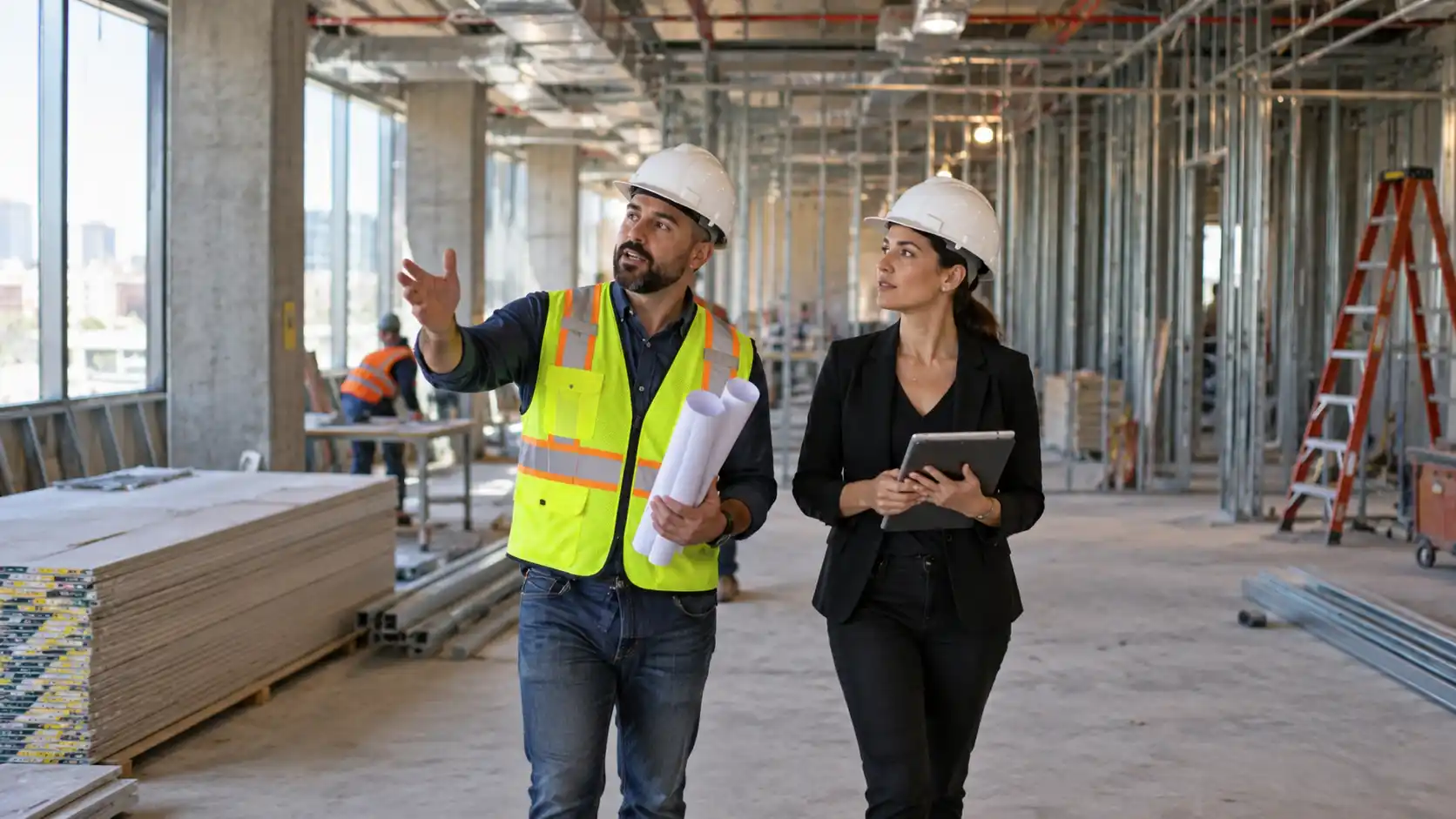
Choosing the right commercial construction company can influence nearly every part of a project, from early planning and budgeting to scheduling, communication, coordination, and final completion. In a large and complex market such as Los Angeles, businesses and property owners may have many contractors to consider, making a structured evaluation process especially useful.
Understanding how to choose a commercial construction company in Los Angeles starts with looking beyond price alone. Relevant experience, a clearly defined scope, transparent contracts, project management, communication, and familiarity with the type of work being completed can all help you make a more informed decision. If you are still defining your project, learning more about available commercial construction services can also help clarify what support you may need.
| Factor to Compare | What to Look For | Why It Matters |
| Relevant experience | Similar commercial projects | Shows familiarity with comparable construction challenges |
| Project scope | Clear inclusions and exclusions | Reduces misunderstandings |
| Estimates | Detailed and transparent pricing | Makes proposals easier to compare |
| Timeline | Realistic milestones and dependencies | Helps with operational planning |
| Communication | Clear contact and update process | Keeps stakeholders informed |
| Licensing and insurance | Applicable and verifiable documentation | Helps manage project and contractual risk |
| Portfolio and references | Relevant completed work | Provides additional context about capabilities |
| Post-construction support | Warranty and correction procedures | Clarifies responsibilities after completion |
What Does a Commercial Construction Company Do?
A commercial construction company might oversee many phases in the development of a building, renovations or enhancements to an existing building. Responsibilities will vary depending on the company and project and may involve pre-construction planning, estimating, scheduling, material coordination, construction management, subcontractor coordinator, site management, and project completion.
Other companies may offer general “end-to-end” assistance with specific phases or work types. Make sure to understand the scope of work a contractor is under contract for, before hiring. For instance, the company can liaise directly with architects and engineers or the latter could be contracted separately to the property owner or developer.

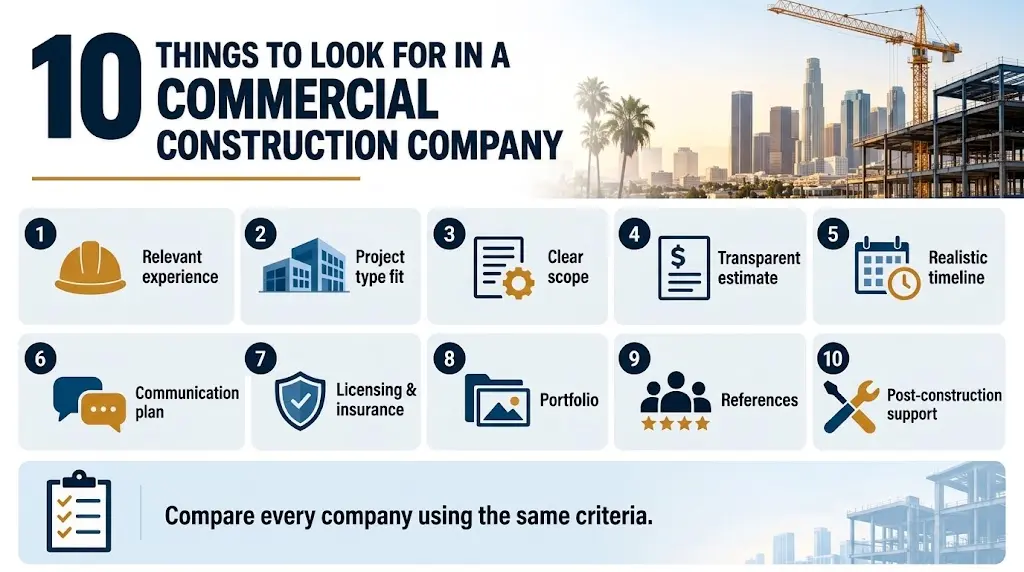
10 Things to Look for in a Commercial Construction Company
Choosing the right contractor will depend on the size, type, complexity, location and goals of your project. The same set of evaluation criteria for all candidates makes it easier to make objective comparisons of commercial contractors.
1. Must have relevant commercial construction experience.
Do not rely on a company’s overall construction history, but instead take a look at their experience as a commercial builder. There can be various coordination needs, stakeholders, timelines, site conditions and operational considerations when compared to a residential project.
Request instances of projects that are not much larger or more difficult than you are. The aim is not to necessarily identify a contractor who has built the same project, but rather if the contractor’s team has faced similar construction challenges.
2. Experience with your project type
Real-world experience is helpful, even more so when it comes to your property or project type. A firm that is knowledgeable about office renovations would likely have a different perspective on a project as compared to one that is geared toward retail, hospitality, commercial renovations or construction of new commercial buildings.
If you have a renovation project, it may also be worth considering how much experience the company has in renovating buildings that are already in use and are occupied. If you’re mainly renovating an existing construction, you can check out their remodeling services to learn if they’re suitable for your requirements.
3. Clear Project Scope
Evaluating a commercial construction proposal will have one of the most important components: a scope that is clear. It should describe what the contractor will do, how, what materials or allowances will be provided and what will not be.
Don’t just compare the totals at the end of the estimates. Two contractors can quote two different prices since one may include more or different work. When signing a contract, it will be helpful to discuss these differences beforehand to avoid any unwanted changes to the contract during the construction period.
4. Information on the status of contracts and agreements
A construction estimate for business should contain sufficient details to enable you to grasp what you are paying for. Examine the significant cost items, allowances, exclusions, payment terms and assumptions in the preparation of the proposal.
The contract should also detail the process for extra work and change orders. Question the implications if the scope of the project changes, if unexpected conditions are found or if a material used changes the original estimate.
5. Project timeline and scheduling.
Have each commercial contractor provide them with an explanation of how they will create and control the project plan. The useful schedule should take into consideration the major construction stages and dependencies which can determine when the work starts or proceeds.
Talk about what materials need to be available, approved, inspected, coordinated through subcontractors, and other things that could impact the schedule. Don’t assume there will be no delays at all, but instead try to find a procedure for when delays happen and how to deal with them.
6. The child’s communication and project management skills.
As more stakeholders participate in a commercial construction project, good communication is more important. When you’re looking to hire a company, be sure to find out who your main point of contact is, and who will be responsible for managing the project on a daily basis.
Determine the frequency of progress reports, how records will be kept and how emergency calls and construction problems will be handled. It can make communication throughout the project more predictable to set up expectations early.
7. Licensing, Insurance and Compliance
When you are about to sign a commercial construction contract, make sure that you understand the licensing and insurance obligations for your project, and are satisfied that the contractor can comply with them.
Permitting, inspections, approvals, building requirements, and other compliance requirements can be subject to change based on project scope and jurisdiction. Have the contractor clarify its scope of responsibility and the owner’s, the architect’s, engineer’s, or other party’s.
8. Previous Projects and Portfolio
By reviewing a construction portfolio, you will get a sense of the kinds of projects that a company has tackled and the breadth of its past projects. Search for projects similar to yours in terms of type of property, complexity, or type of construction.
Don’t assess a portfolio by its looks. Discuss with the contractor what their work was, what they did, and whether it was a new construction, renovation, build-out or other type of project?
9. References and Reviews
Often, a client’s reference will give more information than what is evident on the web or in a proposal. Inquire about communication, project organization, scheduling, change management and how issues were addressed with past clients.
Also, look at online reviews, but keep in mind that they can be helpful, but also take relevance and recency into account. It might be less helpful to review a project that was done many years ago, for a different small project, when you are considering a contractor for a significantly different commercial project.
10. Post-Construction Support
The construction job doesn’t necessarily end when the actual work ends. Inquire about how the company handles final corrections, incomplete items, warranty problems, documentation and follow up requests.
The amount of support after construction is completed is different for each contractor and contract. Ensure that responsibilities are well documented, not assumed that a specific service will automatically be part of it.
Questions to Ask a Commercial Construction Company
Preparing questions before consultations can make contractor comparisons much easier. Ask each company the same core questions and document the answers so you are comparing proposals consistently.
Useful questions include:
- Have you completed commercial projects similar to mine?
- What services are included in your proposed scope?
- What work or services are specifically excluded?
- Who will manage my project?
- Who will be my main point of contact?
- What is the expected project timeline?
- What factors could affect the construction schedule?
- How are project changes and change orders handled?
- How will progress updates be communicated?
- What permits or approvals may be required for this project?
- Who will coordinate inspections and approvals?
- What insurance coverage do you carry?
- Can you provide references or examples of comparable projects?
- How do you select and coordinate subcontractors?
- What happens if construction is delayed?
- What warranties or post-completion support are included?
The answers should provide a clearer picture of how the company operates, not just what it charges.
How to Compare Commercial Construction Companies
Once you have spoken with several contractors, create a consistent comparison rather than selecting the company with the lowest estimate automatically. Price is important, but it should be considered in the context of the actual scope being provided.
Compare relevant experience, project scope, communication, proposed timeline, contract terms, applicable licensing and insurance, portfolio examples, references, project management approach, and post-construction support. A higher proposal may include work that a lower estimate excludes, while a lower proposal may still be appropriate if its scope accurately matches your project.
A simple evaluation table can help:
| Evaluation Area | Company A | Company B | Company C |
| Similar project experience | |||
| Scope completeness | |||
| Estimate clarity | |||
| Proposed timeline | |||
| Communication process | |||
| Contract terms | |||
| Portfolio relevance | |||
| References | |||
| Project management | |||
| Post-construction support |
Using the same criteria helps prevent one attractive feature—such as price or an aggressive completion date—from outweighing other important factors.
What to Expect When Hiring a Commercial Construction Company in Los Angeles
Although every project is different, commercial construction usually moves through several stages before work is completed. Understanding these stages makes it easier to know when decisions will be required.
1. Initial Consultation
The contractor learns about the property, project objectives, desired scope, preliminary budget considerations, and expected timeline.
2. Project Assessment
The company reviews available plans, site conditions, design information, and other project requirements to better understand the proposed work.
3. Scope Definition
Responsibilities, deliverables, materials, exclusions, and construction requirements are clarified.
4. Estimation
The contractor prepares an estimate or proposal based on the available project information and defined scope.
5. Planning and Pre-Construction
The team may coordinate scheduling, subcontractors, materials, documentation, design information, and other activities required before construction begins.
6. Contract and Scheduling
Once the scope and commercial terms are agreed upon, the project can move into detailed scheduling and final preparation.
7. Construction
The contractor manages construction activities according to the agreed scope while coordinating relevant trades and project stakeholders.
8. Final Inspection and Completion
Outstanding items are reviewed, required corrections are addressed, and applicable project documentation or closeout procedures are completed.
The exact process varies according to the project and contractor, so ask each company to explain its workflow before hiring.
Common Mistakes to Avoid When Choosing a Commercial Contractor
One of the most common mistakes is choosing solely based on price. A low estimate can be attractive, but it is only useful when the scope, assumptions, allowances, and exclusions have been carefully reviewed.
Other mistakes include failing to define the scope clearly, not checking experience with comparable projects, overlooking contract details, and failing to ask how change orders will work. Clients should also avoid assuming a completion date without discussing approvals, materials, site conditions, design decisions, and other dependencies that can affect construction.
Another potential problem is beginning a project without clear communication expectations. Knowing who makes decisions, who receives progress reports, and how questions are documented can prevent confusion once multiple contractors and stakeholders become involved.
Commercial Construction in Los Angeles: Local Considerations
Commercial construction in Los Angeles may involve coordination between property owners, contractors, architects, engineers, subcontractors, suppliers, and other professionals. Project location and property conditions can also influence logistics, access, staging, scheduling, and the way construction activities are organised.
Permits, reviews, inspections, building requirements, and approval processes may differ based on project type and the specific authority overseeing the property. For that reason, clients should discuss project-specific requirements with the appropriate professionals rather than assuming that the process will be identical for every Los Angeles commercial project.
Site conditions should also be evaluated early. Access limitations, neighbouring properties, operating businesses, material delivery requirements, and existing building conditions can all affect how construction is planned and scheduled.
For specialised projects, additional expertise may be relevant. For example, a property involving extensive outdoor improvements or luxury pool construction may require different coordination than a standard interior commercial build-out.
When Should You Start Looking for a Commercial Construction Company?
It is generally useful to begin evaluating commercial contractors early enough to allow meaningful planning and comparison before construction needs to begin. Waiting until the desired start date is very close can limit the time available to clarify scope, review estimates, and resolve project questions.
An early contractor selection process allows time for scope development, contractor interviews, proposal comparisons, pre-construction coordination, scheduling discussions, and decisions about materials or project responsibilities.
The right starting point depends on the project’s complexity. Larger projects or those involving significant design and coordination will typically require more preparation than relatively straightforward improvements.
Frequently Asked Questions
How do I choose a commercial construction company in Los Angeles?
Compare companies based on relevant commercial experience, experience with your property type, scope clarity, estimate transparency, communication, project management, timeline, applicable licensing and insurance, previous projects, references, and post-construction support.
Use the same criteria for every company so you can make a balanced comparison.
What should I ask a commercial contractor before hiring them?
Ask about similar projects, included and excluded services, project management, expected scheduling, change orders, permits and approvals, communication, subcontractor coordination, insurance, references, potential delays, and post-construction responsibilities.
The contractor should be able to explain how these areas will be handled for your specific project.
How can I compare commercial construction companies?
Create a comparison checklist and evaluate each company according to the same factors, including scope, experience, estimate details, communication, timeline, contract terms, portfolio, references, project management, and post-construction support.
Comparing equivalent scopes is especially important because two proposals with different inclusions cannot be accurately compared based only on their total price.
Should I choose the lowest commercial construction bid?
Not necessarily. Price is an important factor, but the lowest estimate may have a different scope, exclusions, allowances, timeline, or level of project support.
Review what each proposal actually includes before making a decision. Experience, communication, contract terms, schedule, and project management should also be considered.
What should be included in a commercial construction contract?
Depending on the project, a contract may address scope of work, responsibilities, costs, payment terms, project schedule, allowances, exclusions, change-order procedures, insurance requirements, warranties, dispute procedures, and other applicable terms.
Contract requirements vary, so important terms should be reviewed in the context of the specific project and applicable professional advice.
How long does it take to choose a commercial contractor?
There is no universal timeframe. A relatively straightforward project may require fewer consultations and comparisons, while a larger or more complex development may involve extensive scope review, estimates, interviews, and pre-construction discussions.
Allow enough time to evaluate proposals properly instead of making the decision primarily to meet an aggressive construction start date.
Ready to Discuss Your Commercial Construction Project?
Knowing how to choose a commercial construction company in Los Angeles gives you a stronger framework for evaluating contractors and understanding what each proposal actually offers. Clear scope, relevant experience, transparent contracts, communication, scheduling, and project management should all contribute to the final decision.
If you are planning a commercial project and want to discuss your requirements, Struxa Group can help you explore the project scope, construction considerations, and next steps. You can contact a commercial construction team to begin a conversation about your property and planned work.