
California ADU Permits, Step by Step: What Homeowners Need to Know in 2026


Permits are the part of an ADU project that worries homeowners most, and the part that causes the most delays. The good news: California has some of the most ADU-friendly laws in the country, and state law limits how much cities can slow you down. Here is how the ADU permit process in California works, step by step.
Note: ADU laws change often. This guide reflects California state law as of 2026. Your city may have additional rules within what state law allows.
What California law guarantees you
State ADU law sets the floor for every city in California:
- Fast decisions. A city must tell you within 15 business days whether your application is complete, and must approve or deny a complete application within 60 days. If it does not act in time, the ADU can be deemed approved.
- Ministerial review. If your ADU meets the objective standards, approval is a checklist review, not a public hearing.
- Small setbacks. Side and rear setbacks can be no more than 4 feet for most ADUs.
- No minimum lot size and no owner-occupancy requirement for ADUs.
- Fee relief. No development impact fees for ADUs of 750 sq ft or less, and no school fees under 500 sq ft.
- Multiple units. Many single-family lots can have a detached ADU, a converted ADU and a junior ADU (JADU) together.
The ADU permit process, step by step
Step 1: Check your lot
Before any drawings, confirm the basics: your zoning, lot lines, easements, slope, and where your water, sewer and power lines run. Also check whether your property is in a fire hazard zone or the coastal zone, since both add requirements.
Step 2: Choose your ADU type and size
Decide between a detached ADU, an attached ADU, a garage conversion or a JADU (up to 500 sq ft inside the main house). Size affects fees: staying at or under 750 sq ft avoids impact fees entirely.
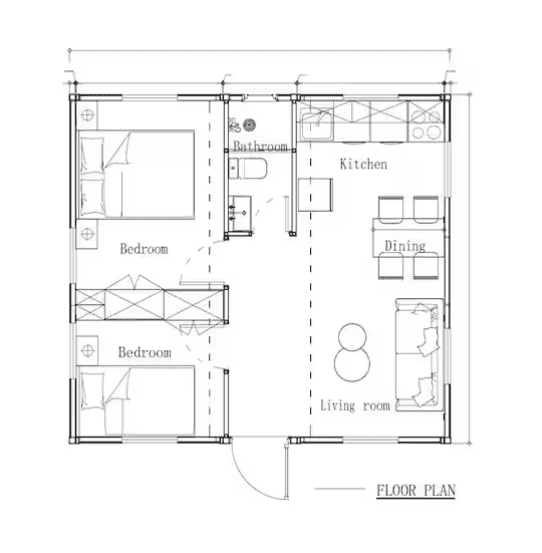
Step 3: Prepare the permit set
A typical ADU permit application includes:
- Site plan showing the ADU, setbacks and utility routes.
- Floor plans and elevations.
- Structural engineering and calculations.
- Title 24 energy compliance report.
- Any city-specific forms, plus fire or coastal documents if they apply.
This is where most delays start. An incomplete or inconsistent set triggers correction rounds that can add weeks or months.
Step 4: Submit and respond to plan check
Your city reviews the plans and may send corrections. A builder who knows the local requirements answers them quickly and completely.
Step 5: Pay fees and pull the permit
Once approved, you pay the remaining fees and receive your building permit. Construction can start.
Step 6: Inspections during construction
The city inspects at key stages: foundation, framing or panels, rough plumbing and electrical, insulation, and final.
Step 7: Final inspection
After the final inspection passes, your ADU is approved for occupancy.

5 permit mistakes that cause delays
- Submitting drawings before checking utility capacity and routes.
- Missing the fire-zone or coastal-zone requirements.
- Designing just over 750 sq ft without realizing the fee impact.
- Using a design that does not match the engineering.
- Slow responses to plan check corrections.
Let Struxa handle your permits
Permitting is included in every Struxa turnkey project. We navigate local building codes, prepare the complete permit set, respond to plan check and secure the approvals, so you do not have to deal with city paperwork. Combined with fast SIPs construction, that is how we deliver move-in-ready homes in 1 to 3 months. See How Long Does It Take to Build an ADU in California?
Frequently asked questions
Do I need a permit for a prefab ADU? Yes. Any ADU used as a home needs a building permit, whether it is prefab or built on site.
Can my HOA stop me from building an ADU? California law limits HOAs from banning ADUs outright, though they may apply reasonable rules. Review your HOA documents early.
Can I rent my ADU on Airbnb? California allows cities to prohibit ADU rentals shorter than 30 days, and many do. Long-term rentals are allowed.
Can I sell my ADU separately? In most cases, no. Some cities have opted into a state law that allows ADUs to be sold as condominiums, but this is still uncommon.
Start with a free lot review
Not sure what your lot allows? Struxa will review your property and tell you what you can build, how big, and what it will take to get approved. New to ADUs? Start with our complete guide to prefab ADUs in California.